Sunday, January 31, 2016

Progress

Dictionary.com defined progress as the development of an individual or society in a direction considered superior or more beneficial than the previous level. I would consider progress as a change of a previous state that aids or raises the expectation of an individual or society.

The progressive era was mostly associated with the early twentieth century. This was a time where progressives were trying to expand large business and hold them more responsible through various regulations. Also progressives worked hard to try to clean up corrupt cities and let people have better living that were previously in slums.

Achievements of the Progressive Era
1. Ban on Alcohol
2. Regulation of Child Labor and Sweatshops
3. Scientifically Managing Natural Resources
4. Americanize Immigrants or Restrict Immigration
5. Regulate Business
6. Address Health Hazards
7. Eliminate Corruption in Government
8. Expand High Schools

Above is just a few achievements and goals of the progressives during this time period. All of the ideas that the progressives had most commonly had the theme of eliminating corruption and ensure a better standard of living. The essential goals were the regulate child labor, address health hazards, and to eliminate government corruption. These goals needed to be achieved so that there was fairness in society and it gave people a better and more enjoyable life. After the essential goals are managing natural resources, regulate businesses, and expanding high schools. These are not top priority but if they are addressed then the standard of living for everyone will be significantly improved. Lastly the ban on alcohol and dealing with immigrants are two issues that can be looked at but are not at the most important issue. These two goals may affect a few people but not a large number so they should held till the end.

Friday, January 29, 2016

100 year predictions

There were many predictions about year 2000 that actually became true like television, flying machines such as UAVs, mobile phones, and color photography. There are also somethings that will be far from coming true like weather machines and ship railways, but ideas like space travel are still at reach and are still changing. Traveling to Mars is still a real possibility but we have already reached to moon. Most of the predictions that came true were based off of ideas or technology that was already present that might aid humans. The ones that didn't come true were combinations of technology that ended up be redundant.

In the future I believe that there will be more automated transportation. The fact that most accidents on the ground are caused by human errors I believe that this trend will be a leading cause to convert to automated transportation. Robotic technology will be more pervasive and most likely in homes for everyone. 

I believe the control of the future has to start with individuals. If individuals bring up or out issues that are "flaws" or need correction then the future will be shaped to so in two paths. One, the issue will be resolved or two, the issue will be ignored and it won't matter and the future will go on bring out the flaw and over use it.

Tuesday, January 19, 2016

How do you Analyze a Political Cartoon?

According to a political cartoon analysis guide, political cartoons tend to have some type of irony and exaggeration so that it is easier for the audience to grasp what the message of the cartoon is. Some items are labeled in the cartoon so that it gives the reader some basic guidelines and the topic for the cartoon. I found out that cartoonists like to use analogies to help readers understand complex ideas by showing them a simple and more familiar one. Cartoonists also use simple objects, or symbols, to represent more complex ideas.

The best way to understand political cartoons if to first look at the picture and read and words that are in the cartoon. Once you have an understanding of the topic and the guidelines of the cartoon you can start to look for the irony in the cartoon. This can be done by looking at the symbols used and some of the objects that help show the irony or exaggerate some parts of the image. Most importantly keep in mind that the cartoon isn't meant to require a lot of thinking if you are looking at the whole picture and see the things that are funny most of the time you understand the message.
US and Caribbean Political Cartoon


In the cartoon to the right the man with the gold club represents the United States of America. This cartoon resembles the period of time when the United States began colonizing the Caribbean islands like Cuba and Puerto Rico. The artist drew the man walking in the Caribbean because the US was practically in control of any island that it colonized. The US had set Cuba up for American economic domination and the sugar economy in Puerto Rico quickly became under the control of the United States. The line of navy ships behind the gentleman represents the ties that each of those countries had to the US.


Philippine War Cartoon
                                                                             In the cartoon to the left Uncle Sam is standing in front of Puerto Rico and Cuba. Both countries are depicted as to be happy and praising Uncle Sam who represents the United States. The Philippines who is looking at Uncle Sam is scared for what is about to happen but Cuba and Puerto Rico is portrayed as everything will be fine and that the Philippines will be happy once they are colonized.


Emilio Aguinaldo Elimination


The cartoon to the right depicts the United States of America, shown as Uncle Sam, trying to capture Emilio Aguinaldo from the Philippines. The US felt that Emilio the legitimate leader of the Philippines was a "thorn in their side", which is why he is shown as the bee. There is an irony of the sign at the bottom of the cartoon. The US was trying to strip Spain form its colonies so they took the Philippines and then remained on the island being hypocritical of the sign.


Friday, January 15, 2016

Potential Documentary

Topic: Elihu Root
Focus: Elihu rise to create international peace
Angle: Elihu Root's background of being a lawyer allowed him to successfully create peace between countries nationally, but when called upon to be a political figure, he was wary to stay away from office so that his judgement would not be clouded by doing what the people want.
Elihu Root


Eddie Aikau Documentary Analysis

The film Hawaiian, The Legend of Eddie Aikau was named this way because Eddie Aikau became a person to look up to in the Hawaiian culture. Eddie Aikau, being a true Hawaiian, worked hard to protect the identity of the whole Hawaiian culture, from surfing to proving how their ancestors found Hawaii. The sport of surfing was beginning to fade in to the image that Californians and Australians were the best surfers. People did not believe that the Polynesians actually found Hawaii, most believe that they stumbled on it upon luck. The ESPN's filmmakers assumed that the audience watching this film would be into surfing so they used his surfing career to hook the audience. If PBS or the History channel were to make a documentary about Eddie it would leave out his exciting surfing career and may very easily lose their audience.

Wednesday, January 6, 2016

Phrenology

We looked at a bust with parts of the the head colored and were asked to figure out what it was. I noticed a name L.N. Fowler and researched it. It brought me to a website with a biography of Lorenzo Niles Fowler. I then learned about phrenology and how it became popular and how it died out. The provenance of this replica was made by Authentic Models in Oregon. Provenance is the origin of something or the earliest history. Though this is a replica and considered as a secondary source for phrenology it could be a primary sourced if you were to find what types of products Authentic Models make.


Monday, December 14, 2015

Professionalizing Police and Fire Departments

The United States had a large population growth between 1880 and 1920. Urbanization was a large result of this population growth. People moved to cities and new inventions were being created but there were also several side effects to urbanization. Cities that were quickly populated had growing crime rates and the citizens became very concerned. The rates of fires were also increasing in the cities and because of this police and fire departments became professionalized.
            As the city grew in population the number of police officers grew as well and their roles were quickly changing. Up until the early 19th century police were called on to run soup kitchens, inspect boilers, standardize weights and measures, and recover lost children. Police officers were seen as social workers and the received pay by the number of arrests made. Before official police departments, officers were loosely organized and worked for the courts and made arrests based on the fee reward of the arrests. This way of loosely policing the community changed as urbanization was happening and new inventions were being created.


            There were several key factors and changes that helped police officers become more efficient on patrol and allowed the creation of having organized station houses. The first key change was the change to hierarchical organization and communication that closely resembled like the military. This allowed for superiority throughout department. In other words this means that there was a station house that an officer would report to and that the station could communicate to the officer on patrol. Communication was now possible due to the invention of the telegraph and the telephone. Officers were now under the executive branch instead of the judicial branch and were free from civil courts. Police officers were being more proactive on the streets rather than sitting in court for a civil case. The second factor was the creation of uniforms. Policemen were now visible and accessible to all people. This allowed parents to locate and officer from the large crowds on the streets if their child was lost. Lastly was the invention of the automobile. Automobile significantly increased the activity of police officers because there were able to be more mobile and independent. Motorcycles were used to chase traffic violators and officers now obtained radio cars to receive a report on while patrolling the streets for illegal activity. Police departments were only one part of a city’s community service that was professionalized.
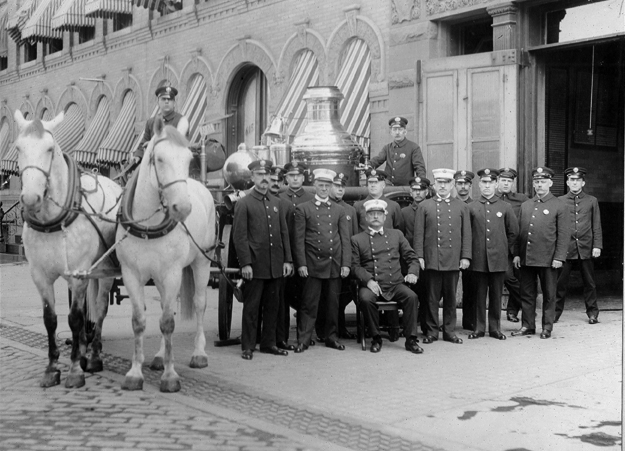
Brooklyn Fire Department
            Fire departments played a large role in the period of urbanization. People were quickly moving into the cities and space for housing became limited, the only option was to build up instead of out. So contractors started doing that, buildings were being built taller but there was a lack of cooling and heating so centralized heating units were invented. Imagine you are living in a small little apartment with five people and have a heating unit on. Space is tight and you’re not the only apartment suffering. After the combination of heating units and skyscrapers combined fire rates went up really fast. This caused the creation of professional fire departments.
Steam Fire Engine
            Benjamin Franklin had started fire stations, but they were mainly volunteer stations, and though there still are many professional stations there are still some that are volunteer based. Franklin believed that everyone should carry around a leather bucket so that if the occasion did arise they had the proper materials to put out a fire. This belief led to the creation of volunteer fire station but this idea was not favored as urbanization came along. Just like the police officers there were many key factor that made volunteers undesirable. First was the refusal of internal change. New technology was being developed and new inventions were created for the stations as well, for example like the steam fire engine. The New York City fire station was built a new steam fire engine but they refused to take it because the volunteers that would then be needed were reduced. Secondly the firehouses were seen as meeting places that would corrupt younger kids. Citizens of the city feared this and wanted the have professional fire departments. Third was the amount of rivalries between stations got out of hand and so there needed to be some organization. Each firehouse decided to make a private enterprise but this was impossible because the government had already given volunteers a fixed salary and invested into some fire departments so that they remained stable. By the government investing in some departments it took out the competition of others but there were still some town that were able to keep volunteer departments because the city government did not have enough money to fund them.

New York Police Patrol 1900
            Urbanization had many effects on cities across the United States. The amount of people that were moving into the country during 1880 to 1920 was tremendous and a lot of problems were created. As a result crime rates went up and so did the frequency of fires. Professional police departments were created and fire departments as well. Today some us believe that the way we see policing hasn’t changed a while to be honest it was just about one hundred years ago that the standards were changed. We take for granted police departments, professional fire departments, and volunteer fire departments because we cannot imagine life without all the technology and with it present the world could spin out of control without and public services to ix our dumb mistakes.
Sources:

History of Urban Police
I used this source to help me get a better understanding of the history of policing.
Police- Encyclopedia of Chicago
This website was used for me to see an example of how policing was changed in a certain city.
Reform- Professionalism
This reform article helped me specifically see how reform and professionalism was created with police departments.
Development of Fire Departments
I used this article to better inform me of how fire departments were created and how they were changed.
Deployment Changes
The article on deployment changes allowed me to understand the changes of deployment and to see if there were different views of how deployment changed.
History of Policing
I used this link to teach myself the way policing has changed and why. This article made me come up with my own inferences about urbanization.